If you own property in Chapel Hill and OWASA just sent you a backflow notice, you’re not alone, and you’re not in trouble yet. Backflow testing Chapel Hill property owners deal with every year is a routine, well-documented requirement, not a mystery. This guide breaks down what backflow prevention actually does, who needs it, how the annual test works, and what happens if you let the deadline slide.
Why Chapel Hill Takes Backflow Prevention Seriously
Chapel Hill draws its drinking water from a small, shared system. The Orange Water and Sewer Authority (OWASA) treats water at the Jones Ferry Road Water Treatment Plant and pulls from Cane Creek Reservoir, University Lake, and Quarry Reservoir. One contaminated connection can put that entire supply at risk.
OWASA defines a backflow prevention device simply: a plumbing fixture that keeps water moving in one direction only, so nothing on your property can travel back into the public main.
Backflow itself happens when water pressure drops, and it drops more often than people expect. A water main break, a burst of firefighting activity, or heavy demand elsewhere on the system can all pull water backward through an unprotected connection. That backward pull can drag fertilizer, irrigation runoff, or chemicals from a lab sink straight into the drinking water main.
Chapel Hill’s mix of properties raises the stakes further. The town holds UNC campus buildings, teaching hospitals, research labs, and dense student housing within a few square miles of ordinary homes. That combination is exactly why OWASA requires the connections most likely to introduce contamination to install and maintain approved backflow assemblies.
Who Actually Needs Chapel Hill Backflow Testing
OWASA’s cross-connection ordinance requires an approved backflow assembly on connections with a real potential to introduce contamination into the public system. In practice, that covers a long list of everyday situations.
In-ground irrigation systems top the list. OWASA states plainly that it requires approved backflow prevention on all irrigation systems tied into the public water supply in Chapel Hill, no exceptions for a small residential sprinkler head or two.
Fire sprinkler systems, commercial kitchens, medical and dental offices, laboratories, car washes, and any property with a secondary water source (like a well used alongside the public supply) fall under the same rule. Even single-family homes can be required to install a device if OWASA determines it’s necessary for that specific service line.
Standalone homes without irrigation, pools, or secondary plumbing hazards are usually the exception rather than the rule. If you’re unsure whether your property needs one, OWASA’s own guidance points customers to check the North Carolina Drinking Water Act or deq.nc.gov, since the requirement list isn’t exhaustive.
How OWASA’s Annual Testing Requirement Works
North Carolina state law requires every testable backflow prevention assembly to be tested annually by a certified tester, and OWASA enforces that rule locally through its Cross-Connection Control Manual. Testing isn’t optional paperwork, it’s a legal condition of staying connected to the water system.
OWASA delegates parts of the testing and reporting process to a designated third-party vendor, and results have to reach that vendor or OWASA directly. If an assembly fails its test, the owner has 15 business days to repair or replace it, get it retested, and submit the new report.
There’s one useful carve-out for irrigation owners. As of OWASA’s 2025 policy update, irrigation backflow devices that stay in service year-round with no chemical feed or booster pump can move to a three-year testing cycle instead of an annual one, as long as the owner certifies each year that no chemical feed is present. That’s a genuinely helpful change if your irrigation setup qualifies, so it’s worth asking your tester whether you’re eligible.
OWASA’s broader cross-connection rules were updated across 2024 and 2025, following changes to North Carolina Session Law 2024-49. If your last test was more than a year or two ago, the requirements may have shifted slightly since then, so it’s worth confirming current specifics before assuming last year’s paperwork still applies.
What Happens During the Test
A certified tester connects a calibrated test kit to the assembly and checks that each internal check valve and relief valve holds pressure the way it’s designed to. The whole process usually takes well under an hour for a standard residential or small commercial device.
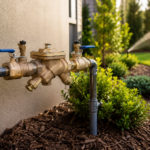
Reduced Pressure Principle (RPZ) assemblies, Double Check Valve Assemblies (DCVA), and Pressure Vacuum Breakers each get tested slightly differently, since they’re built to fail in different ways depending on the hazard level they’re protecting against. Your tester will know which device you have and test it to the correct standard.
If everything passes, the tester files the report with OWASA or its designated vendor, and you get a copy for your own records. If something fails, the fix is usually a valve or seal replacement rather than a full assembly swap, and a good tester carries common parts on the truck so a second visit isn’t necessary.
What Happens If You Miss the Deadline
OWASA’s ordinance gives the utility real teeth here. If OWASA determines that an imminent hazard exists at a property, water service to that building can be terminated unless the cross-connection is fixed immediately or an air gap is put in place.
Even short of an emergency shutoff, an overdue or failed device leaves the property out of compliance and exposed to enforcement action under the ordinance. Reconnecting service after a shutoff typically means more paperwork, more delay, and more cost than simply testing on time would have.
The practical fix is unglamorous but effective: put the testing date on a calendar, respond to OWASA’s notice when it arrives, and book a certified tester before the deadline creeps up on you. It’s a fifteen-minute administrative task that saves a genuinely bad week.
Signs Your Backflow Preventer Needs Attention Now
A few warning signs shouldn’t wait for the annual test. Water pooling around the assembly, a hissing or dripping relief valve, unusually low water pressure, or discolored water are all reasons to call a tester right away rather than waiting for the next scheduled visit.
Winter deserves special mention. A hard freeze can crack a backflow assembly that isn’t properly protected, and OWASA notes it doesn’t require heated enclosures on smaller residential lines, which means freeze protection is largely the homeowner’s job. Insulating or wrapping an exposed assembly before the first cold snap costs far less than replacing a cracked one in January.
Rubber components inside the assembly also wear out on a schedule of their own; OWASA’s manual calls for replacing internal rubber parts every five years regardless of how the device performs on a given test. A tester who flags this proactively is doing you a favor, not upselling you.
Choosing a Certified Tester for Backflow Testing in Chapel Hill NC
OWASA only accepts test reports from North Carolina state-certified backflow testers, and OWASA maintains its own list of approved vendors for the area. Working with someone already familiar with OWASA’s specific submission process, rather than a generic statewide directory listing, tends to move faster.
A licensed plumbing contractor generally has to be the one installing or replacing an assembly in the first place, per OWASA’s Cross-Connection Control Manual, while fire line assemblies specifically require a licensed fire sprinkler contractor. Testing and installation aren’t always the same license, so it’s worth confirming both when you’re comparing companies.
Arbor Plumbing & NC Backflow serves the Raleigh-Durham-Chapel Hill Triangle, handling licensed plumbing work alongside backflow testing, repair, and OWASA-compliant reporting. Property owners searching for Chapel Hill backflow testing get one point of contact for the test, the paperwork, and any repair the device needs, without juggling a separate irrigation company, plumber, and testing vendor for one annual task.
The Bottom Line
Backflow prevention protects a water supply shared by a university, two hospitals, and thousands of households, which is exactly why OWASA and North Carolina state law treat annual testing as non-negotiable. The requirement is not designed to catch anyone out; it’s designed to catch problems before they reach the tap.
Backflow Testing Chapel Hill NC residents deal with each year is genuinely one of the lower-effort compliance tasks a property owner will handle, provided it happens before the deadline rather than after a service interruption. A quick call to a certified, OWASA-familiar tester keeps the paperwork current, the water safe, and the whole process about as painless as plumbing compliance gets.