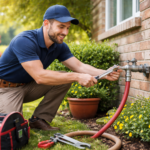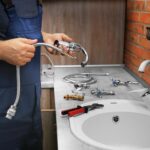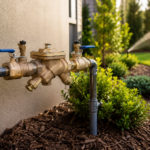
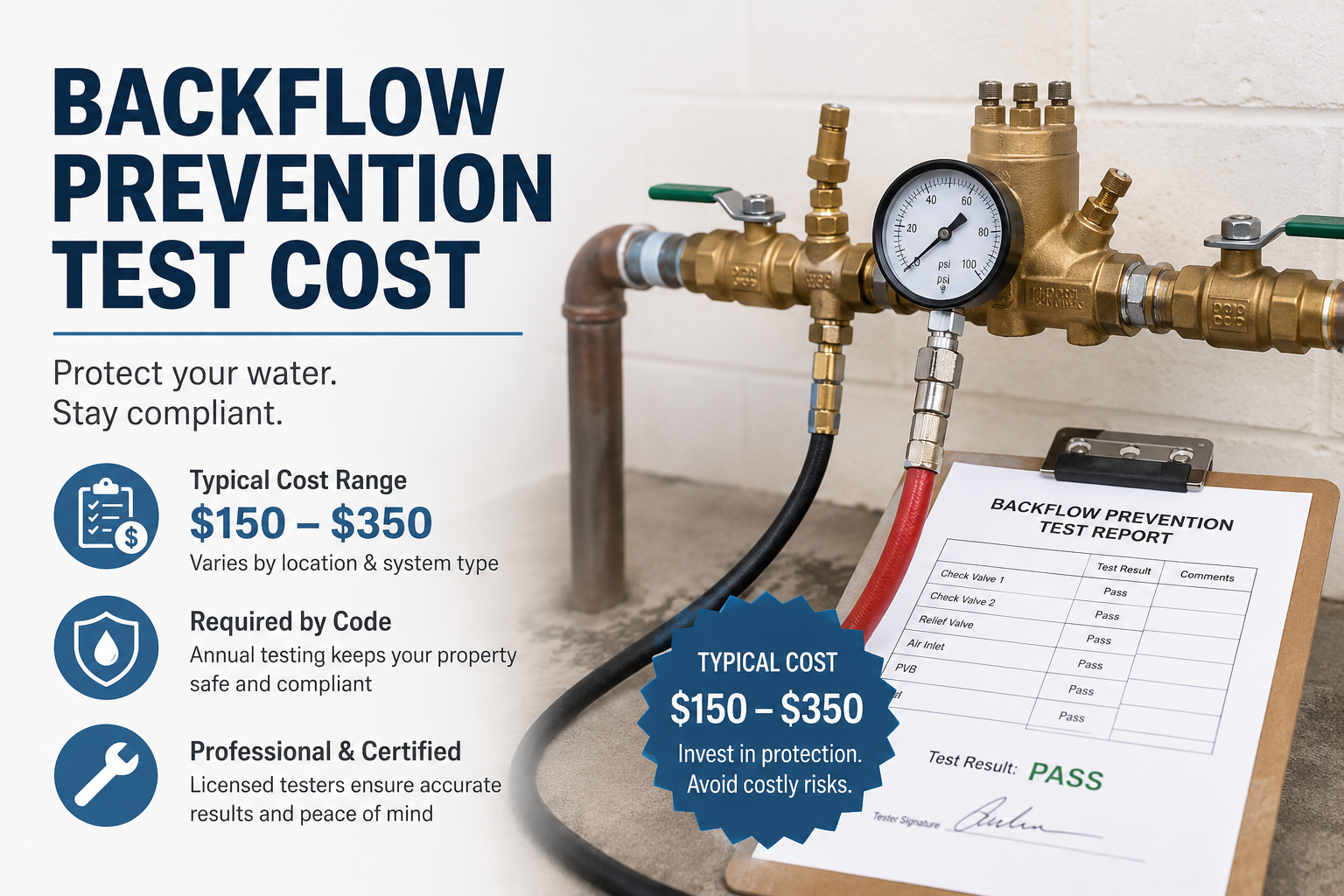
Your backflow preventer works quietly in the background. Nobody notices it until a test fails, a city notice shows up, or worse, dirty water finds its way back into a clean water line. Then everyone has questions, starting with the big one: what does this actually cost?
We pulled real numbers from national cost databases and NC utility rules to answer that clearly. No guessing, no inflated numbers, no scare tactics.
What a Backflow Preventer Actually Does
A backflow preventer is a small valve with a big job. It keeps water flowing in one direction, from the clean municipal supply into your home or business, and never the other way around.
Without one, a sudden drop in city water pressure can pull water backward out of irrigation systems, pools, or fire lines. That backward pull can drag fertilizer, chemicals, or stagnant water into the drinking supply. Most cities in North Carolina, including Raleigh and Durham, require a working device wherever that risk exists.
Backflow Preventer Testing Cost: The National Range
Cost estimates vary by source, but they land in a fairly consistent band once you compare a few of them.
- Angi puts standard backflow testing at roughly $70 to $90 per test.
- HomeGuide reports a wider range of $30 to $300 per device, depending on location and whether the test uncovers a problem.
- Backflow Rates lists a typical national range of $75 to $150 for a standard test.
- City Backflow Testing, a Texas-based provider, estimates most systems tests fall between $100 and $150.
Put those together and a fair rule of thumb for a single residential or light commercial device lands around $75 to $150 per test, with simple jobs on the low end and multi-device commercial properties pushing higher.
Backflow Repair and Replacement Costs
If your device fails testing, repair costs typically run $50 to $100 for minor fixes, according to Angi’s cost data. A full replacement unit, installed, generally costs $200 to $1,000 depending on the size and type of assembly, per HomeGuide’s pricing breakdown. HomeAdvisor’s research lands installation costs in a similar $150 to $450 range for most residential setups.
Here’s the logic: testing is cheap insurance. Waiting until a device fails outright, especially one buried near a foundation or irrigation main, turns a $75 test into a much bigger job.
What Actually Changes Your Price
A few factors push backflow testing cost up or down:
Number of devices. Most homes have one assembly. Commercial buildings, restaurants, and properties with fire suppression systems often run two or three, and each one gets billed separately.
Access. A valve tucked behind landscaping or buried under a deck takes longer to reach. Time is money, even for a five-minute test.
City reporting fees. Some municipalities charge a small filing fee when the tester submits your results. That’s usually rolled into your quote, not billed separately.
Repairs found during testing. A device that fails its first check needs a second visit and retest once it’s fixed, which adds cost.
Backflow Testing Cost in Raleigh, NC
Raleigh runs one of the more structured cross-connection control programs in the Triangle. Here’s what that means for your wallet and your calendar.
The City of Raleigh Public Utilities Department requires annual testing of all backflow prevention assemblies, and results must go to the city within 10 days of the test. This isn’t optional paperwork. It’s written into Raleigh’s Code of Ordinances under Article D, Water Quality Protection.
One detail that trips people up: Raleigh’s water service area stretches well past the Raleigh city line. It also covers the merger towns of Garner, Wake Forest, Rolesville, Knightdale, Wendell, and Zebulon. So if your property sits in Garner, you’re still following Raleigh’s testing rules, notification schedule, and reporting process.
Only certified testers using calibrated gauges can perform the official test and file it with the city. Homeowners occasionally ask if they can test their own device. Technically the equipment exists, but the city only accepts reports from registered, certified testers, so a DIY test won’t satisfy the requirement.
Backflow Repair in Durham
Durham runs a similar program through its Water Management Department, also requiring annual testing by certified professionals for every backflow assembly in the system.
When a device fails in Durham, repair costs follow the same general pattern as the rest of the region: $50 to $100 for minor part replacements, more if the issue involves corrosion, a cracked housing, or a valve that needs full replacement. Piedmont soil conditions and older neighborhoods with aging service lines can add complexity to repairs, so a technician who knows Durham’s infrastructure tends to work faster than someone unfamiliar with the area.
How Often Does Testing Need to Happen?
Annually, in nearly every case across the Triangle. Raleigh, Durham, and Cary all require yearly testing for commercial and testable residential assemblies, and the city sends a reminder notice roughly 30 days before the due date. That reminder is a courtesy, not a guarantee. The property owner carries the responsibility if a test gets missed.
New assemblies also need an initial test at installation, before final permit approval. Skip that step and your project can stall at inspection.
Choosing a Certified Backflow Tester
Not every plumber is authorized to test and report backflow assemblies. Look for:
- Current NC certification through an approved school (Raleigh, Durham, or Charlotte-Mecklenburg’s programs all qualify)
- Registration with your city’s cross-connection control program
- A calibrated test kit, since uncalibrated equipment can produce a false pass or fail
- A written report submitted directly to the city on your behalf
A properly certified tester saves you a second trip. An uncertified one might hand you a report the city won’t even accept.
Frequently Asked Questions
Does a $70 test cover repairs too? No. Testing and repair are billed separately in almost every case. A passing test costs the base fee. A failing one adds repair costs plus a retest.
Do residential homes without irrigation need testing? Usually not, unless the property has a pool, well, or another cross-connection risk. Standard residential water lines with no irrigation system typically use a simpler dual-check device that doesn’t require annual testing.
What happens if I skip my annual test? Cities can escalate from reminder notices to fines, and in serious cases, water service interruption. It rarely reaches that point, but ignoring repeated notices is what triggers enforcement.
Is backflow testing cost the same for commercial and residential properties? Per-device pricing is similar, but commercial properties often have more devices and larger assemblies, which raises the total invoice even though the per-unit rate doesn’t change much.
The Bottom Line
Budget somewhere between $75 and $150 for a standard backflow test in the Raleigh-Durham area, more if you’re running multiple devices or a commercial assembly. That’s a small number next to the cost of a failed inspection, a compliance fine, or contaminated water making its way into your home.
Arbor Plumbing & NC Backflow tests and repairs backflow assemblies across Raleigh, Durham, Garner, Cary, and the surrounding Triangle. If your annual notice just landed in the mailbox, or you’re not sure your last test even happened, reach out and we’ll get it handled before it becomes a bigger problem.